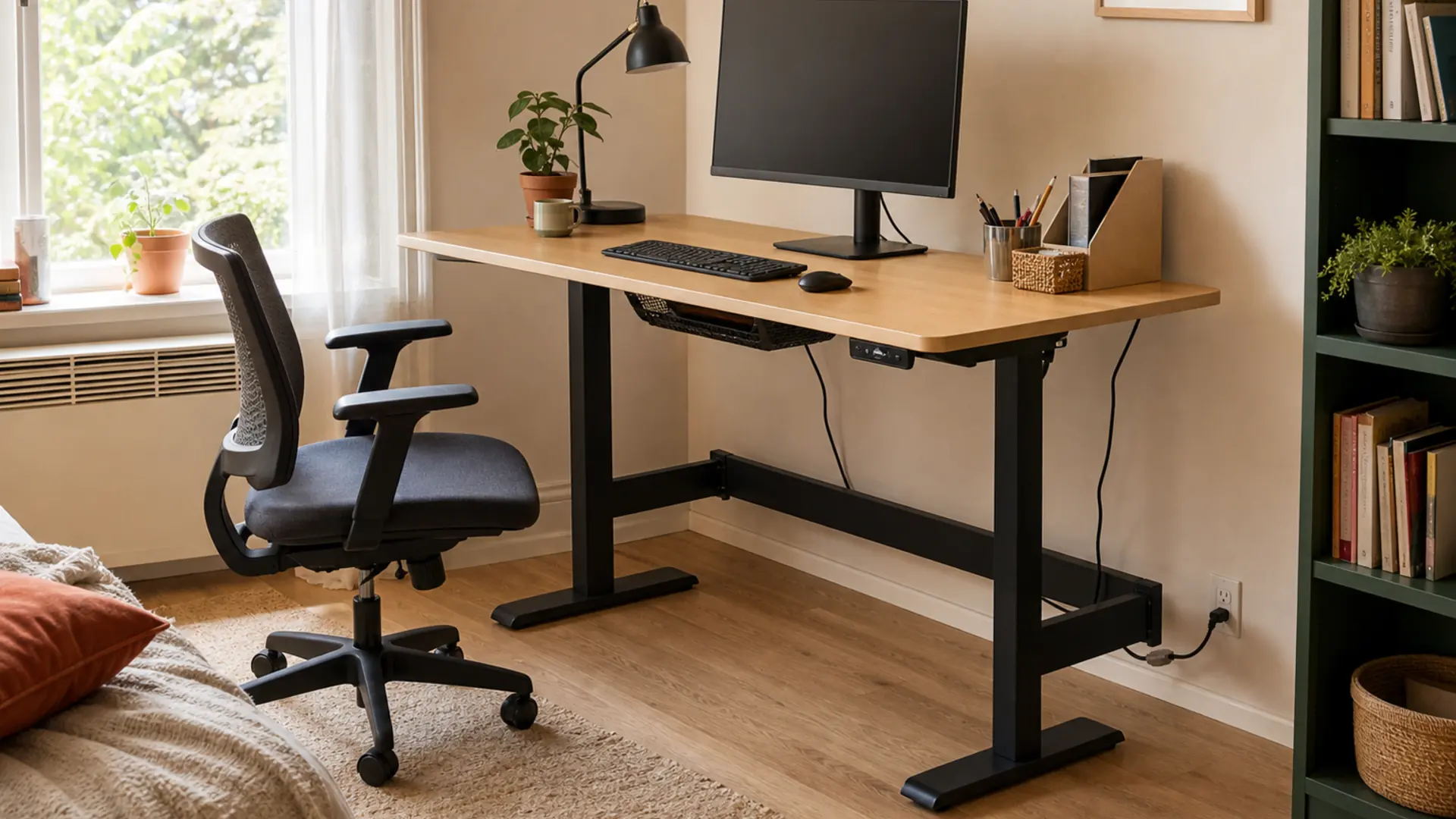
A practical reading of best standing desks under 500
Confirm the desk reaches a useful seated and standing height.
Stability depends on the real surface, equipment, and extension.
Last updated: July 2026 · 10 min read
We research and compare products independently. Some links on this page are affiliate links, which means we may earn a small commission at no extra cost to you. We only recommend products we genuinely believe belong in a healthy workspace.
Standing desks are one of those purchases you put off because the good ones look expensive, and the cheap ones look wobbly. And honestly - that's a fair concern. A $300 desk that shakes like a leaf at standing height isn't a deal; it's a waste of $300.
But here's the thing: the budget standing desk market has matured significantly over the last three years. You can now get dual motors, decent stability, and real warranty coverage for under $500. The two-segment lift columns and cheap stepping motors of 2020 have been replaced by three-stage frames and brushless motors that rival desks twice the price.
This guide aggregates specs, reviews, and user experiences from across the web to help you find the best standing desk under $500 for your specific needs. No fake reviews, no sponsored rankings - just real data and honest comparisons.
Why Standing Desks Matter
You've probably seen the studies. Sitting for eight-plus hours a day is associated with increased risk of cardiovascular disease, type 2 diabetes, and even certain cancers. A 2024 meta-analysis in the European Journal of Preventive Cardiology found that prolonged sedentary time was linked to a 24% higher risk of all-cause mortality - regardless of exercise habits. That last bit is key: hitting the gym for an hour doesn't undo the other seven hours you spent in a chair.
Standing desks aren't a cure-all, but they're one of the most practical tools for breaking up sedentary time. A 2023 study from the University of Pittsburgh showed that participants who used sit-stand desks reduced total sitting time by roughly 60 minutes per day compared to those with traditional desks. Over a year, that's about 365 extra hours of movement and better circulation.
There's also the pain piece. Lower back discomfort is the most common complaint among office workers, and it often stems from poor seated posture and hip flexors that shorten after hours of sitting. Standing - even for 15 to 30 minutes at a stretch - engages your core, opens your hips, and changes the load on your spine. A systematic review in Cochrane found moderate evidence that sit-stand desks reduce sitting time in the short and medium term, particularly when paired with behavioral support like standing reminders or walking meetings.
But let's be honest about what standing desks don't do: they won't make you fit, they won't cure your back pain overnight, and standing all day comes with its own set of problems (varicose veins, joint strain, foot fatigue). The goal is "position variability" - switching between sitting and standing throughout the day, not replacing one static posture with another.
That's why a quality standing desk matters. A cheap, unstable desk will rattle your monitors, irritate you every time you adjust it, and ultimately send you back to sitting full-time. A desk with smooth lift, solid build, and easy transition controls makes you actually want to stand. And in the under-$500 range, you can absolutely find one that does that.
Types of Standing Desks
Before we get into specific picks, it helps to understand the three main categories you'll encounter. Each has tradeoffs, and the best choice depends on your budget, workspace, and tolerance for manual labor.
Electric Standing Desks
These are what most people picture when they think "standing desk." A motor (or two) drives the legs up and down at the push of a button. The big advantages: effortless height changes, memory presets that let you switch between sitting and standing heights instantly, and smooth movement even with heavy monitors on the desktop.
Under $500, you'll mostly find single-motor desks. That's fine for most setups - a single motor driving a crossbar can lift 100-150 pounds without issue. Dual-motor desks (one per leg) are smoother, faster, and handle heavier loads, but they typically start around $450 and go up from there. The tradeoff at the budget end is that some single-motor desks can be a bit slower (about 1 inch per second vs. 1.5-2 ips on dual-motor models) and may struggle with very heavy monitor arms loaded with 32-inch displays.
Manual Crank Standing Desks
Manual crank desks use a hand crank to raise and lower the frame. They're the cheapest option by a wide margin - you can get a crank desk for under $200 that covers the same height range as a $500 electric model. The obvious downside: you have to physically turn the crank, which takes about 30 to 60 seconds and a moderate amount of effort. If you only adjust once or twice a day, it's honestly not that bad. If you're the type who switches positions every hour, you'll quickly regret skipping the motor.
Manual desks are also simpler mechanically. No motors to fail, no wiring to deal with, no limit switches to adjust. For a home office where the desk gets light use, a crank desk can last for years without issue. Just don't expect to keep it on a deep carpet - the crank mechanism needs clearance underneath, and cranking on carpet is an exercise in frustration.
Desk Converters (Risers)
Desk converters sit on top of your existing desk and lift your monitor and keyboard up to standing height. They're a great entry point if you're not ready to replace your whole desk, if you're in a rental and can't swap furniture, or if your budget is really tight (good converters start around $100).
The tradeoff: converters have limited height range (usually 15-20 inches of lift), less desk space for accessories, and can feel cramped. They also tend to wobble more than a full desk frame, especially gas-spring models that rely on a single piston. If you're under 5'4" or over 6'2", finding a converter with the right ergonomic fit is harder. But for a budget-first, low-commitment option, they absolutely work.
For this guide, we're focusing on full-size standing desks (electric and manual crank), since that's what most people looking under $500 actually want. Converters deserve their own dedicated guide.
What to Look For in a Standing Desk Under $500
When you're shopping on a budget, it's tempting to just sort by price and pick the cheapest option. Don't. Here's what actually matters.
Stability
This is the number-one complaint about budget desks. At sitting height, almost every desk feels fine. At standing height (40-44 inches), a flimsy frame will wobble every time you type or bump the desk. Look for three-stage legs (more overlap = less play), a crossbar or T-foot design (widens the base), and frames with at least 2-inch-wide columns. User reviews on Reddit and Amazon consistently call out specific models for wobbliness - avoid anything with a narrow base or thin legs unless you're using a laptop only.
Motor Quality
Single-motor desks under $300 usually use basic DC motors. They're fine for light use but tend to be noisy (50+ dB) and slow. Dual-motor desks and higher-end single-motor models use brushless motors that run quieter (under 45 dB) and last longer. For budget picks, a Jiecang or Loctek motor is a good sign - these are the same OEMs used by many premium brands.
Height Range
Check the minimum and maximum height. If you're shorter than 5'4", you need a desk that goes down to at least 28 inches (25-26 is better). If you're over 6', you need at least 48 inches at full extension. Many budget desks have a range of 28-47 inches, which works for most people between 5'4" and 6'. Outside that range, you'll need to look more carefully at specs.
Weight Capacity
Your desk needs to hold your monitor(s), keyboard, accessories, monitor arm, and anything else you keep on it. A single 32-inch ultrawide monitor on an arm weighs about 20 pounds total. Add a laptop, speakers, desk lamp, and a few knickknacks, and you're at 50-60 pounds easily. Most budget desks claim 120-175 pounds capacity - but that's usually under ideal conditions (evenly distributed load, center of the desk). Be conservative: if you plan to load up your desk, aim for a model rated at least 150 pounds.
Desktop Material
Under $500, you're mostly looking at particle board with laminate, MDF, or solid bamboo. Laminate particle board is standard and fine - it's durable, stain-resistant, and easy to clean. MDF is heavier and denser but prone to damage if moisture gets in. Bamboo is the premium option in this price range: harder than most hardwoods, sustainable, and naturally antimicrobial. Some budget desks let you supply your own desktop, which means you can splurge on a butcher block or solid wood slab for the same total cost.
Memory Presets
On an electric desk, memory presets let you save your preferred sitting and standing heights and switch between them with one button press. It sounds like a luxury, but after a week of using a desk with presets, you'll never want to hold a button for 15 seconds again. In the under-$500 range, memory presets are common on desks $350+. Below that, you're looking at manual height adjustment only (holding the up/down button until you guess the right height).
Warranty and Customer Support
This is where budget desks diverge sharply. The best budget desks offer 5-7 year warranties on the frame and 2-3 years on electronics. The worst offer 1 year on everything or "limited lifetime" that covers the frame only and is a nightmare to actually claim. Read the warranty terms carefully. Also, check the return policy: some Amazon sellers charge return shipping on large items like desks, which can cost $50-100.
Top Picks Under $500
These are the desks that deliver the best combination of stability, build quality, and value at their respective price points. Recommendations are based on spec sheets, verified buyer reviews, forum discussions, and ongoing community sentiment. Prices reflect U.S. retail as of July 28, 2026.
FLEXISPOT EN1 One-Piece Standing Desk 48x24
- Type: Single-motor, two-stage electric
- Desktop size: 48 x 24 in, one piece
- Height range: 28.9" - 46.5"
- Weight capacity: 176 lbs
- Memory presets: Yes, 4
- Warranty: Not stated on the listing
- Rating: 4.5 stars across 12,586 ratings
This slot used to belong to the IKEA TROTTEN, a $199 manual crank desk. IKEA has flagged every TROTTEN variant as clearance or last-chance, so we needed a new ultra-budget pick — and the EN1 makes the old one look like a bad deal. It's roughly half the price and the height changes at the press of a button instead of 35 turns of a crank. On a page whose entire argument is "you will only stand if standing is frictionless," that is not a small difference.
Four memory presets at $109.97 is genuinely unusual; most desks don't get presets until $350 or so. The 176 lb capacity is fine for two monitors, a laptop, and the usual desk clutter. And the top ships in one piece, which matters more than it sounds: seamed three-piece desktops flex where the panels meet, and that's exactly where people clamp monitor arms.
Where it gives ground. It's a single-motor, two-stage frame. Two stages means less column overlap, so expect more sway at full extension than the three-stage desks further down this page, and a single motor driving a crossbar lifts more slowly than a dual-motor pair.
The one that might rule it out: the desk stops coming down at 28.9 inches. The TROTTEN went to 22. If you're under about 5'2", the EN1 will never reach a correct seated height for you, and there is no adjustment on the desk or the chair that fixes that — you would be raising your chair to meet the desk and then hunting for a footrest. Shorter users should buy the FLEXISPOT E6 below (23.6") instead, even though it costs more.
The bottom line: The cheapest desk on this page that we'd actually tell someone to buy — provided you're tall enough for it.
SHW Electric 55" Standing Desk
- Type: Single-motor electric
- Desktop size: 55 x 28 in (also available in 48" and 63")
- Height range: 28.3" - 45.7"
- Weight capacity: 176 lbs
- Desktop material: MDF with laminate
- Memory presets: No (hold button to adjust)
- Warranty: 3 years
- Colors: Black, white, walnut
The SHW Electric desk is the most popular budget electric model on Amazon, and for good reason. We had it at $299; it's $189.87 as of July 28, 2026. For that you get a 55-inch wide desktop, a surprisingly stable frame for the price, and a claimed 176-pound weight capacity that's among the highest at this money.
The single motor is a basic DC unit. It's not whisper-quiet - expect around 50 dB during operation, which is audible but not annoying unless your office is dead silent. The lifting speed is about 1 inch per second, which is average for a single-motor desk. There are no memory presets, so you'll be holding the button up or down until the desk reaches your preferred height. It's a minor annoyance once you get used to it, but worth noting if you adjust frequently.
Stability is the pleasant surprise here. At full height (45.7 inches), there's minimal wobble for a desk in this price bracket. The crossbar design and steel T-frame do their job. Users with two 24-inch monitors on separate arms report acceptable stability for daily work, though aggressive typing on a heavy mechanical keyboard still causes some screen shake.
The laminate MDF desktop is decent. It's not hardwood, but the walnut finish looks better than you'd expect at this price. The edges are beveled and the surface is smooth. It arrives in one piece, so assembly is straightforward - just attach the legs to the pre-drilled frame, mount the crossbar, and flip it over. Budget about 30-45 minutes total.
The main downsides: the height range stops at 28.3 inches minimum, which is too high for anyone under 5'6". And the 3-year warranty is mid-range - it covers motor and frame defects, but you'll deal with Amazon's return process for issues within the first 30 days. After that, customer support responsiveness varies.
The bottom line: Best entry-level electric desk for average-height users who want a wide surface and electric lift for well under $200.
FLEXISPOT E6 3-Stage Dual Motor Standing Desk 55x28
- Type: Dual-motor electric, three-stage legs
- Desktop size: 55 x 28 in, one piece
- Height range: 23.6" - 48.8"
- Weight capacity: 220 lbs
- Desktop material: One-piece FSC-certified top
- Memory presets: Yes
- Warranty: 5 years frame and motor, 2 years electronics
What happened to the Branch. This slot held the Branch Standing Desk at $499 for as long as this guide has existed. As of July 28, 2026 Branch no longer sells a desk under that name, and the old product URL now serves a different desk at $749. That isn't a price change, it's a different product — so the pick is gone rather than quietly repriced.
The E6 replaces it, and it wins the slot on the two things the Branch won it on. First, three-stage legs. More column overlap means less play at full extension, and that is the single biggest predictor of whether a budget desk feels solid when you type standing up. Second, dual motors — one per leg rather than one motor dragging both through a crossbar — which lift more evenly under an off-centre load like a monitor arm clamped to one side.
Height range is the other reason it's here: 23.6 to 48.8 inches is the widest span on this page. The 23.6-inch minimum is what makes this desk usable by people around 5'0"–5'2", who are shut out of both the EN1 (28.9") and the SHW (28.3"). At the top end, 48.8 inches covers standing height for most people over 6 feet.
The desktop arrives in one piece and is FSC-certified. That's worth a sentence because the alternative at this price is a three-panel top with seams running across the surface — seams that flex, collect crumbs, and sit exactly where you'd want to clamp an arm.
Weight capacity is 220 pounds, which covers dual monitors, a desktop tower on the surface, and anything else short of gym equipment.
Where it gives ground. The five-year cover is on the frame and motors. The electronics — control box and keypad — are covered for two. On budget sit-stand desks the control box is the most common failure, so read that split as what it is: the part most likely to break has the shortest warranty. It's still better cover than the SHW's, and $214 below where the Branch pick sat.
The bottom line: The best standing desk under $500 on this page, and the only one here that comes down low enough for short users. Dual motors, three-stage legs, and a one-piece top for $284.99.
VIVO Electric 63x32 Standing Desk (2E Series)
- Type: Electric, three-stage legs (frame is likely single-motor)
- Desktop size: 63 x 32 in, three pieces
- Height range: 24.6" - 50.2"
- Weight capacity: 220 lbs
- Warranty: 3 years
If what you actually need is surface area, this is the one. 63 by 32 inches is far larger than anything else under $500 here — room for an ultrawide plus a laptop plus paperwork, or a genuine dual-27" setup with the depth to sit back from both. The 24.6" to 50.2" range is nearly as generous as the E6's and taller at the top end.
The trade: the desktop ships in three pieces, so there are seams across the working surface, and the frame is likely single-motor rather than dual. Both matter if you clamp a heavy arm to one side. Take the E6 if you want the steadier desk; take this if the extra 8 inches of width and 4 of depth solve a real problem for you.
Side-by-Side Comparison
| Desk | Price | Type | Height Range | Capacity | Desktop | Presets | Warranty |
|---|---|---|---|---|---|---|---|
| FLEXISPOT EN1 | $109.97 | Single-motor, 2-stage | 28.9" - 46.5" | 176 lbs | One-piece | 4 | Not stated |
| SHW Electric | $299 | Single-motor | 28.3" - 45.7" | 176 lbs | MDF laminate | No | 3 yrs |
| FLEXISPOT E6 | $284.99 | Dual-motor, 3-stage | 23.6" - 48.8" | 220 lbs | One-piece FSC | Yes | 5 yrs frame / 2 yrs electronics |
| UPLIFT V3 | $599 | Dual-motor | 25.5" - 51.5" | 355 lbs | Various | 4 | 7 yrs |
| Vari Electric | $650 | Dual-motor | 26" - 50" | 200 lbs | MDF laminate | 4 | 5 yrs |
Worth the Stretch? Desks Over $500
If your budget can flex another $100-$150, there are two desks worth considering. Neither is strictly "better" than the Branch for the average buyer, but they address specific needs that the sub-$500 category can't fully cover.
UPLIFT V3 - $599
The UPLIFT V3 is the most configurable standing desk on the market at any price. The 355-pound weight capacity is the highest of any desk in this guide - you can safely mount dual ultrawide monitors, a full desktop PC, studio monitors, and a heavy mixer without worrying. The programmable advanced control box includes an anti-collision sensor, and the frame itself is almost universally praised for rock-solid stability at any height.
What you're really paying for at $599 is the customization. UPLIFT offers dozens of desktop sizes, materials, finishes, and grommet configurations. You can get a 72" x 30" rubberwood butcher block, a carbon fiber look, a recycled teak, or any of about 30 other options. If you need a desk that's exactly 60 inches wide in a specific color, Uplift has it. Branch and SHW don't.
The 7-year warranty is comparable to Branch's, and Uplift's customer support reputation is strong - they're known for sending replacement parts quickly even years after purchase. The tradeoff is cost: with a 60-inch bamboo desktop (Uplift's closest to Branch's configuration), you're paying about $150 more than the Branch.
Vari Electric Standing Desk - $650
Vari (formerly Varidesk) is one of the best-known names in standing desks, and their electric model is popular in corporate buying. It's a solid, dual-motor desk with 4 memory presets, a 200-pound weight capacity, and a 26 to 50-inch height range.
The build quality is industrial-grade. The steel frame is thick and the laminate desktop is durable enough for commercial office use. Assembly takes about 20 minutes, which is faster than most competitors. Stability is good but not class-leading - at full extension, there's slightly more wobble than the UPLIFT V3 (which costs less, interestingly).
The $650 price is hard to swallow when the Branch and Uplift both cost less and offer better specs on paper. You're paying for the name and the corporate procurement pipeline - Vari is available through many enterprise retailers and has a well-documented bulk purchasing program. For individual buyers, the Branch is the smarter choice at this price level.
Setup Tips for Your New Standing Desk
A standing desk is only as good as its setup. Here are practical, experience-backed tips to get the most out of your purchase.
Cable Management
The moment after you build your desk and see the mess of cables dangling underneath is a special kind of horror. Handle it before it gets worse. A cable management tray is a $15–$30 investment that pays for itself in sanity. Look for one that mounts underneath the desktop with pre-drilled holes and has enough width to hold a power strip and a few bricks. Velcro cable ties are your next best tool — bundle cables by destination (monitor, computer, peripherals) and route them along the desk legs. Some budget desks like the Branch come with cable trays included. If yours doesn't, the IKEA SIGNUM cable tray ($15) is a solid universal option, or the ECHOGEAR under-desk cable management tray ($25) for a tool-free install.
Get an Anti-Fatigue Mat
Standing on a hard floor for extended periods hurts. Your feet, knees, and lower back will all protest within 20–30 minutes. An anti-fatigue mat provides cushioning and micro-movement that keeps blood flowing and reduces joint strain. The consensus across physical therapy forums is that wedge-shaped mats with a textured surface offer the best balance of comfort and durability. Expect to spend $30–$60 for a good one. Skip the ultra-thin foam mats sold for kitchen use — they compress quickly and provide negligible support for standing work. Two solid options: the ComfiLife anti-fatigue floor mat ($33) for a budget pick, or the Ergodriven Topo mat ($60) for a premium textured surface that encourages movement.
Leave Your Shoes Off (or Wear the Right Ones)
This sounds trivial, but it's one of the most common recommendations from ergonomic specialists. When you stand barefoot or in socks, your feet can articulate naturally and your ankles maintain a full range of motion. Shoes with thick, padded soles (most athletic shoes, dress shoes) reduce proprioception and can actually make standing more tiring because your feet can't sense and adjust to the ground as effectively. If you need footwear, look for zero-drop minimalist shoes or supportive house slippers with thin soles. Birkenstocks and their variants are popular in the standing-desk community for exactly this reason.
Transition Gradually
Don't try to stand for four hours on day one. You will hate it, your body will hurt, and you'll conclude that standing desks are a fad. They're not - you just need to build tolerance. Start with 15 minutes of standing per hour for the first week. Increase to 20-30 minutes per hour in week two. By week four, most people can comfortably stand for 40-45 minutes before needing to sit. A timer or standing reminder app helps. Apple Watch users can set a "stand" reminder every hour; there are also desktop apps like BreakTimer that give you visual alerts.
Monitor Height Is Non-Negotiable
Your eye level should hit roughly the top third of your monitor. If you have to tilt your head down or up, your neck will pay for it. This means that when you raise the desk to standing height, your monitors probably also need to go up. A monitor arm is the cleanest solution — it clamps to the desk, adjusts independently of the desk surface, and lets you dial in height and tilt exactly. For under $30, a basic gas-spring arm transforms your ergonomics — the VIVO single monitor gas-spring arm ($30) is a reliable budget pick. Under $100, you get smooth multi-monitor setups like the WALI dual monitor mount ($45). Don't skip this.
Set Up Your Keyboard and Mouse Position
Your elbows should form a 90-degree angle when typing, with your forearms parallel to the floor. At standing height, that usually means the keyboard tray or desktop surface should be level with or slightly below your elbow. A lot of budget desks don't come with a keyboard tray, and adding one after the fact can be tricky because the desk legs and crossbars eat up clearance space. Measure before buying. A simple solution is to adjust the desk height so your elbows hit that 90-degree position with the keyboard on the desktop itself, then raise your monitors on arms to compensate for the lower desk position.
Frequently Asked Questions
A $300 standing desk is absolutely worth buying if you need a desk now and have a hard budget cap. The Flexispot E7 and SHW both offer electric height adjustment at this price, and they'll get the job done for 3-5 years. The main trade-offs are stability at max height (some wobble), fewer features (no programmable presets or anti-collision), and shorter warranties. If you expect to keep the desk for 7+ years, saving for a $600-800 model makes sense. If you need a desk today, $300 gets you a perfectly serviceable one.
Single-motor desks use one motor connected to both legs via a crossbar. Dual-motor desks have separate motors in each leg. For the sub-$500 category, single-motor is the norm. Dual-motor is better for heavier loads, faster lifting, and smoother operation—but they rarely appear under $500. At this price point, focus on stability and weight capacity rather than motor count.
Electric is dramatically more convenient for daily adjustments. Pressing a button takes 5 seconds; cranking takes 30-60 seconds. That friction adds up over a year of daily transitions. A hand-crank desk is fine if you only adjust height once a day, or if you're on a very tight budget, but for frequent transitions, the $50-100 premium for electric is one of the best investments you can make.
Some wobble is normal at standing height (40-50 inches) on any desk, but it should be minimal—a few millimeters of sway when you lean on it, not a full-fledged shimmy when you type. The Flexispot E7 is the most stable in the sub-$500 range, with minimal wobble even at max height. C-frame desks wobble more than T-frame desks. If wobble bothers you, keep the desk at a lower height or budget for a T-frame model.
Yes, with a few caveats. You need a desk with enough height range to accommodate your setup—most standing desks go from 28-48 inches, which works for standard treadmills. At walking/biking height, you'll want the desk at 40-45 inches depending on your height. Make sure the desk has enough depth to fit your monitor arm off-center so the treadmill can sit under the desk. A wider desktop (55-60 inches) is ideal for treadmill setups.
48x24 inches is the minimum for a single-monitor laptop setup. 55x24 inches is the sweet spot for single-monitor with paperwork. 60x30 inches (if you can fit it) is ideal for dual monitors or an ultrawide. Depth matters more than most people realize—24 inches minimum, 30 inches is better for comfortable viewing distance with large monitors.
Most budget standing desks take 30-60 minutes to assemble with basic tools. The Flexispot E7 and SHW both come with illustrated instructions and include an Allen wrench. The hardest part is typically mounting the legs to the frame crossbars and flipping the desk upright. Two people make assembly much easier.
Most budget standing desks include a basic mesh cable tray that mounts under the desktop. These are functional but not elegant—they'll hold a power strip and some cables, but you'll want aftermarket velcro ties and possibly a J-channel raceway for a truly clean look. Some models (Flexispot E7) include grommet holes for routing cables through the desktop, which is a nice touch.
Yes, if the total load (monitors + mount + laptop + accessories) stays under 100-150 lbs. Most monitors weigh 10-15 lbs each, a dual monitor arm adds 5-8 lbs, and a laptop adds 3-5 lbs—so you're well within the weight capacity. The bigger concern is desktop depth: 24 inches minimum for dual 24-inch monitors, 30 inches recommended for 27-inch monitors. Also budget for a good monitor arm since you'll want to reposition screens.