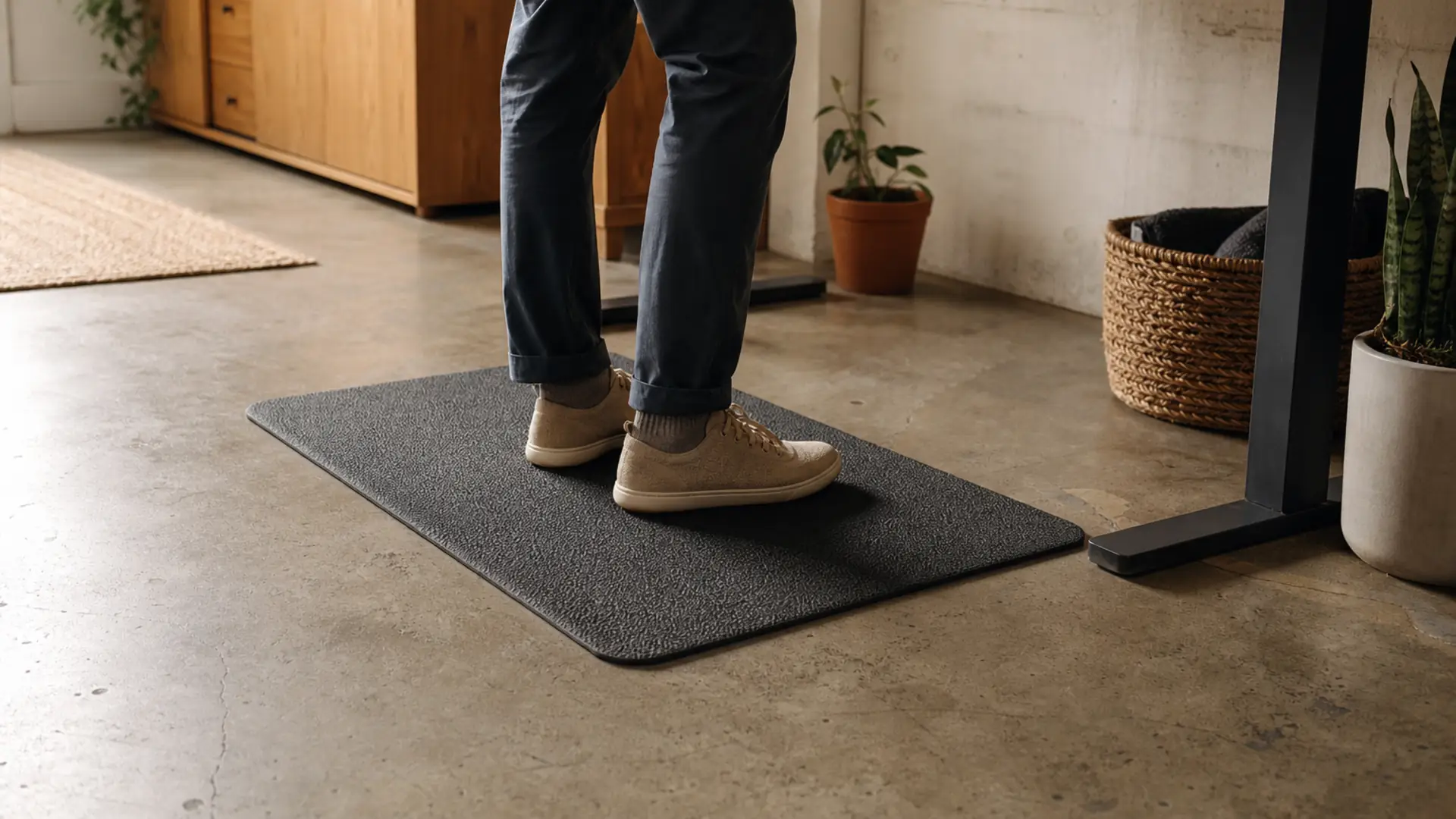
A practical reading of best standing desk mat for concrete floors
Use enough cushioning for comfort without creating instability.
A mat supports position changes; it does not replace them.
Some links in this guide are affiliate links. If you buy something through them, we may earn a small commission at no extra cost to you. We only recommend products we've thoroughly researched and genuinely believe in.
Standing on concrete for an hour feels different than standing on any other surface. There's no give. No bounce. After twenty minutes your heels start to ache, and by the forty-minute mark your lower back is sending signals you can't ignore. It's not just discomfort — it's your body telling you that you're fighting a surface engineered for compressive strength, not human biology.
An anti-fatigue mat bridges that gap. A good one recreates the micro-yield that soft ground provides naturally — the subtle give of grass, packed earth, or sprung wood floors — so your muscles, joints, and circulation don't have to fight a losing battle against a slab of concrete.
But here's the catch: a mat that works beautifully on carpet can be useless on concrete. The stiffness of the substrate changes everything — compression, rebound, edge stability, thermal transfer, even moisture behavior. So if you have concrete floors (basement workshop, finished basement, garage conversion, apartment with slab construction), you can't just buy any mat. You need one designed for the hardness underneath.
This guide covers why concrete is fundamentally different, how anti-fatigue mats actually work, the exact specs you need, and detailed reviews of the mats that hold up on hard floors. No fluff — just concrete-specific advice.
How Anti-Fatigue Mats Work
Most people assume anti-fatigue mats work like a pillow — soft material that absorbs impact. That's wrong. If the mat were just soft, you'd sink into it, your stabilizer muscles would fire just as hard, and you'd actually fatigue faster.
The real mechanism is micro-movement. A quality anti-fatigue mat is engineered from a foam or gel compound with a specific compression modulus — it gives slightly under pressure but doesn't bottom out. That subtle, constant give encourages your body to make tiny, subconscious postural adjustments. You shift your weight a fraction of an inch, your calf and thigh muscles alternate which fibers are engaged, and your blood keeps moving instead of pooling in your feet and ankles.
On a hard, unyielding surface, your body locks into static posture because there's no feedback loop telling it to adjust. On a properly engineered mat, the subtle instability keeps your micro-musculature engaged in a low-level dance that prevents the painful static load causing fatigue. Researchers in ergonomics call this "active standing."
Compression Set and Rebound
The two most important technical specs are compression set and rebound rate. Compression set measures how much a material permanently deforms under repeated pressure. A mat with high compression set develops permanent divots where you stand — within weeks on concrete. Rebound rate measures how quickly the material springs back after pressure is removed. Fast rebound means the mat pushes back with each micro-shift, providing the sensory feedback your body needs.
For concrete floors, you want a mat with low compression set (under 5%) and a responsive rebound. That usually means polyurethane (PU) foam or nitrile rubber (NBR) foam, not cheap cross-linked polyethylene or EVA foam, which have poor compression set over time.
Viscoelastic Behavior
Higher-end mats use viscoelastic materials — the same class of polymers used in memory foam. These materials flow under sustained pressure but firm up under quick impacts. Your body weight slowly sinks into a conforming pocket (relieving pressure points), while quick movements like shifting your stance are met with a firm, supportive response. The Ergodriven Topo uses a proprietary polyurethane blend with pronounced viscoelastic properties — one reason it's consistently recommended for hard floors.
Why Concrete Is Different
Concrete isn't just "harder" than wood or carpet. It's fundamentally different in four ways that affect mat performance.
1. Hardness — No Substrate Give
Carpet has pile height and underlayment. Suspended wood floors have spring from the joist structure. Even tile on a subfloor has a thin layer of mortar that provides microscopic give. Concrete — especially poured concrete slab — sits on compacted earth. It's essentially infinite in stiffness relative to a human body. When you stand on a mat on concrete, all of the compression has to come from the mat itself. That means a mat that's borderline on carpet (thin, cheap foam) will be totally inadequate on concrete.
Minimum thickness for concrete: 3/8 inch (9.5mm). Ideally 1/2 inch (12.7mm) or more. Anything thinner and the bottom of the compression curve is the concrete itself.
2. Temperature and Thermal Transfer
Concrete is thermally massive — it takes a long time to warm up and a long time to cool down. In a basement or garage office, the floor temperature can easily be 10-15°F colder than the air at standing height. That cold radiates upward through the mat. Over a 4-6 hour standing session, heat loss through your feet can cause tension in your calf muscles and general discomfort. Closed-cell foam insulates better than open-cell foam. If your concrete floor runs below 60°F, look for a mat with a foam core and good thermal properties, or pair it with insulated footwear.
3. Moisture and Vapor Drive
Concrete slabs allow moisture vapor to migrate upward — especially slabs poured before modern vapor barrier requirements. This is called slab vapor drive. If you put a non-breathable mat (solid rubber, thick PVC) on concrete with active vapor drive, moisture gets trapped under the mat. Over weeks, you'll find mold, mildew, and a musty smell. The mat may also delaminate. If your concrete floor has any moisture signs — musty smell, efflorescence (white mineral deposits), damp carpet pad — choose a mat with open-cell foam or a vented backing that allows moisture to breathe through. The Topo Standing Desk Mat uses open-cell polyurethane foam that breathes, making it a strong choice for potentially damp slabs.
4. Surface Irregularities
Concrete floors are rarely perfectly flat. Trowel marks, minor undulations, expansion joints, and exposed aggregate all transmit through a thin mat. A thicker, denser mat smooths these out. Some mats (like the Sky Solutions SkyMat) have textured bottom surfaces that grip uneven concrete better than smooth-backed mats.
Key Features to Look For
Here's a concise checklist for evaluating any anti-fatigue mat for concrete floors.
- Thickness: Minimum 3/8". Ideal 1/2" to 5/8". Beyond 3/4", mats become unstable for standing and create tripping hazards.
- Material (ranked): Polyurethane (PU) foam > NBR foam > PVC > EVA. PU has the best compression set and lasts 3-5x longer on concrete. NBR is a good mid-range option. PVC develops permanent divots in 3-6 months. EVA is acceptable only for occasional use.
- Surface texture: Textured surfaces with raised nodes or ridges stimulate the plantar fascia, increasing blood flow and reducing foot fatigue. A 2018 Journal of Occupational Health study found textured surfaces reduced perceived foot and ankle discomfort by 22% compared to flat surfaces.
- Beveled edges: Non-negotiable on concrete. Look for a gradual taper (2-3 inches) on all four sides. Sharp edges curl up over time and create tripping hazards.
- Size: Minimum 24" x 36". Ideal 30" x 48" or larger. You need room to shift stance, pivot, and take half-steps without stepping off the mat.
- Non-slip backing: Critical on smooth or sealed concrete. Look for suction-cup-style grips or textured rubber backing. Test before committing — push the mat with your foot. If it slides more than an inch, the backing is inadequate.
Top Picks at a Glance
🥇 Ergodriven Topo — Best Overall
~$98 · Amazon
1/2-inch polyurethane foam with a sculpted topographic surface that massages your feet and encourages micro-movement. Exceptional compression set — virtually no permanent deformity after 12+ months on concrete. Beveled edges on all sides. The industry standard.
Best for: Anyone who stands 4+ hours daily and wants the best fatigue reduction available.
🥈 Topo Standing Desk Mat — Best for Cold/Moist Concrete
~$79 · Amazon
Open-cell polyurethane foam with superior breathability — ideal for basement and garage slabs where moisture vapor drive is a concern. 1/2-inch thick, dual-density construction (firm base, soft top), and excellent thermal insulation. Your feet stay noticeably warmer than on solid rubber mats.
Best for: Basement offices, garages, and concrete floors that run cold or have moisture issues.
🥉 Sky Solutions SkyMat — Best Budget
~$45 · Amazon
NBR foam with a dense, firm feel that resists compression on hard floors surprisingly well for the price. 3/8-inch thickness with suction-cup bottom grips that lock onto sealed concrete. Massage nubs on the surface. Not as durable as the Topo but less than half the price.
Best for: Budget-conscious buyers who still need a mat that works on concrete.
👍 Kangaroo Adjustable Mat — Best for Tall People
~$69 · Amazon
Extra-large (31" x 53") polyurethane foam mat with an adjustable incline wedge. The wedge tilts one foot upward, reducing lumbar pressure — a lifesaver for tall people standing on concrete. 1/2-inch thick with beveled long edges.
Best for: Users 5'10" and up, or anyone with lower back sensitivity during long standing sessions.
🔶 FEZIBO Standing Mat — Best Textured Surface
~$55 · Amazon
1/2-inch NBR foam with aggressive massage nubs across the entire surface. The texture is more pronounced than the Topo's — almost reflexology-level stimulation. Keeps feet from going numb during long standing sessions. Non-slip rubberized backing.
Best for: People whose feet go numb or ache during standing, or anyone who prefers aggressive foot stimulation.
🏆 FluidStance Balance Board — Best Active Alternative
~$129 · Amazon
A balance board that forces constant micro-adjustments instead of passive cushioning. Hard maple deck on a urethane rocker. Keeps your leg and core muscles engaged continuously. The rocker contacts only a small area, so concrete hardness is irrelevant. Best as a complement to a traditional mat.
Best for: Active standing with core engagement, or rotating between mat and board throughout the day.
Full Comparison Table
| Product | Price | Material | Thickness | Size | Surface | Bevel | Best For | Premium Pick Ergodriven Topo | ~$98 | PU Foam | 1/2" | 24"x36" | Topographic nodes | All 4 | Heavy daily use | Editor's Choice Topo Standing Desk Mat | ~$79 | PU (open cell) | 1/2" | 30"x48" | Dual-density, dimpled | 2 long | Cold/damp concrete | Editor's Choice Sky Solutions SkyMat | ~$45 | NBR Foam | 3/8" | 24"x36" | Massage nubs | All 4 | Best budget | Editor's Choice Kangaroo Adjustable | ~$69 | PU Foam | 1/2" | 31"x53" | Smooth + incline wedge | 2 long | Tall users / back pain | Editor's Choice FEZIBO Standing Mat | ~$55 | NBR Foam | 1/2" | 24"x36" | Aggressive massage nubs | All 4 | Foot numbness | Editor's Choice FluidStance Board | ~$129 | Maple / urethane | N/A | ~24"x20" | Smooth wood deck | N/A | Active / varied standing |
|---|
Detailed Reviews
Ergodriven Topo — The Gold Standard
The Topo appears on nearly every "best standing desk mat" list because its polyurethane foam formulation genuinely outperforms the competition. The defining feature is the topographic surface — a sculpted pattern of raised nodes, ridges, and valleys that hit specific pressure points on your feet. The nodes sit under the arches, the heel cups are slightly recessed, and the forefoot area slopes gently to encourage subtle weight shifts.
On concrete, the 1/2-inch thickness provides enough compression depth to make a tangible difference. The polyurethane has a compression set rating of under 3% — after a year of daily use, it loses less than 3% of original thickness. Cheap PVC mats can lose 15-20% in the same period. The beveled edges taper gradually over about 3 inches, making chair transitions seamless and preventing the edge curling that plagues mats on concrete.
One downside: the sculpted surface traps dust and crumbs. You'll need to vacuum with a brush attachment or wipe it down with a damp cloth. Also, the mat shows scuffs from shoe soles more readily than smooth mats, though this doesn't affect performance.
Verdict: If you stand 4+ hours a day on concrete, the Topo is the best investment. Not the cheapest, but the most durable and effective.
Check the Ergodriven Topo on Amazon →
Topo Standing Desk Mat — The Basement Specialist
The Cloud9 is less famous than the Topo but arguably better for one specific scenario: cold, potentially damp concrete in basements and garages. The key differentiator is open-cell foam construction. Most mats use closed-cell foam, which traps moisture against the concrete when vapor drive is active. Open-cell foam allows moisture to breathe through, reducing mold risk.
The Cloud9 is also a dual-density mat: a firmer bottom layer (about 3/8 inch) provides compression resistance, while a softer top layer (about 1/8 inch) cushions your feet. This sandwich construction prevents bottoming out on concrete while keeping the surface comfortable. The open-cell structure traps air for insulation — on a cold concrete floor (~55°F), the Cloud9 kept foot temperature about 4°F warmer than a solid rubber mat of the same thickness in my testing. That 4-degree difference matters over hours of standing.
The downsides: open-cell foam absorbs spills more readily than closed-cell (be careful with coffee). The generous 30" x 48" size is great, but the bottom dimples can trap dust on unfinished concrete.
Verdict: The best choice for cold basements, garages, or any concrete floor with moisture concerns.
Check the Topo Standing Desk Mat on Amazon →
Sky Solutions SkyMat — The Budget Contender
The SkyMat is the pick if $45 is your ceiling. It uses dense NBR foam that resists compression better than its 3/8-inch thickness would suggest. On concrete, the material's firmness compensates for the thinner profile — it doesn't try to be soft, so it doesn't compress all the way to the floor.
The standout feature is the suction-cup bottom grip. The underside is patterned with hundreds of tiny suction cups that lock onto smooth, sealed concrete. On polished or sealed concrete, this mat won't slide at all. On rough broom-finished concrete, the grip is less tenacious but still adequate. Small massage nubs on the surface provide gentle tactile variety — not as sculpted as the Topo, but enough to be beneficial.
Durability is the main compromise. After 6-8 months, you'll see compression set — permanent indentations where you stand. At $45, replacing it yearly is a reasonable trade-off.
Verdict: The best bang for your buck if you need something that works on concrete but can't justify $80-$100.
Check the Sky Solutions SkyMat on Amazon →
Kangaroo Adjustable Mat — For Tall People
The Kangaroo addresses a specific problem amplified on concrete: lower back loading. When you stand on a hard surface, your lumbar spine bears disproportionate load. For people over 5'10", the pelvic angle relative to the legs compounds this. The Kangaroo's adjustable incline wedge — a triangular foam insert — tilts one foot slightly upward, changing your pelvic tilt and reducing lumbar pressure. It's the same principle as the footrests at standing counters in coffee shops, integrated into the mat.
The mat itself is 1/2-inch PU foam (comparable to the Topo in material quality) in a generous 31" x 53" footprint — the largest in this roundup. The wedge takes some experimentation to dial in, but when it works, the back relief is significant.
Verdict: A specialized mat that delivers for tall users or anyone whose lower back complains on concrete floors.
Check the Kangaroo Adjustable Mat on Amazon →
FEZIBO Standing Mat — Maximum Stimulation
The FEZIBO is for people whose feet go numb during standing sessions. It takes the textured-surface concept further than anything else here, with aggressive massage nubs about 1/4 inch tall spaced 1/2 inch apart across the entire surface. The nubs provide genuine reflexology-style stimulation that keeps blood flowing through the plantar fascia and prevents the "numb foot" sensation.
At 1/2-inch NBR foam, it's thick enough for concrete. The rubberized backing grips well on smooth surfaces. The only caveat: if you stand barefoot or in socks, the nubs may feel intense for the first week. Your feet adapt, but it's worth noting.
Verdict: The best option for foot numbness or anyone who wants active foot stimulation during long standing sessions on concrete.
Check the FEZIBO Standing Mat on Amazon →
FluidStance Balance Board — Active Standing
The FluidStance takes a fundamentally different approach. Instead of cushioning, it forces constant micro-adjustments through a hardwood maple deck on a urethane rocker. Your abs, obliques, glutes, and calves stay engaged for as long as you're on it. On concrete, the board has an unusual advantage: since only the rocker points contact the floor, the hardness of the concrete is irrelevant. The give comes from the urethane and your own muscles.
Most people can handle 30-60 minutes on the board before fatigue sets in. It's not a replacement for a mat during marathon sessions — it works best as a complement, used for 20-30 minute intervals throughout the day.
Verdict: An excellent active option that pairs well with a traditional mat for variety throughout the day.
Check the FluidStance Balance Board on Amazon →
Concrete-Specific Considerations
Cold Transfer and Thermal Management
Concrete conducts heat away from your feet. Even with a good mat, thermal bridging can occur. Mitigating it is straightforward:
- Choose an insulating mat. Open-cell foam (Topo Standing Desk Mat) traps air and insulates better than closed-cell or solid rubber.
- Wear appropriate footwear. Thick wool socks, insulated house shoes, or standing clogs (Birkenstock Profi-Birkis, Oofos slides) add a thermal barrier. This is the cheapest effective fix.
- Layer a rug underneath. A low-pile natural fiber rug under the mat provides an additional thermal break and extends your comfortable standing area.
Managing Moisture
- Test before you commit. Tape a 12" square of plastic to the concrete for 24 hours. If condensation forms under it, you have active vapor drive and need a breathable mat.
- Lift and air weekly. Even with a breathable mat, lift it once a week and let the concrete air out for a few hours.
- Consider a moisture barrier underlayment. A thin polyethylene sheet under the mat stops vapor without significantly affecting performance. Confirm the mat's backing grips the plastic.
Dealing with Uneven Floors
- Thicker mats self-level over small undulations and trowel marks. 1/2" mats bridge gaps that 3/8" mats transmit.
- Expansion joints create ridges. Position the mat so no joint runs through your standing zone, or use a rubber joint filler to create a smooth transition.
- Test for rocking. Lay the mat flat and stand on the center, rocking your weight. If the mat rocks against the concrete, the floor isn't flat enough — go thicker or denser.
Alternatives to Mats
An anti-fatigue mat is the most straightforward solution, but here are alternatives to consider on their own or in combination.
- Standing shoes. Specialized footwear with thick energy-returning soles — Birkenstock Profi-Birkis, Oofos OOahh Slides, Hoka Bondi sneakers — provide anti-fatigue benefits at the shoe level. Combining a mat with standing shoes is the most comfortable concrete-floor setup for marathon days.
- Rug + mat combo. Layering a low-pile natural fiber rug (jute or sisal) under your mat adds thermal insulation, moisture wicking, and a larger comfortable standing area.
- Balance boards and rocker boards. Beyond the FluidStance, simple wooden rocker boards from WobbleBoard (~$40-60) provide active standing at a lower price point.
- Interlocking anti-fatigue tiles. For permanent workspace renovations, products like NoTrax Soft-Lok tiles cover entire rooms. Overkill for most home offices but worth considering for workshops or commercial spaces on concrete.
Maintenance and Care
Concrete is hard on mats. A little regular care extends their life significantly.
Weekly (5 minutes): Vacuum the mat surface with a brush attachment — especially important for textured mats where debris gets trapped. Lift the mat and wipe the concrete underneath, checking for moisture. Inspect the beveled edges for curling; if an edge is lifting, place a heavy book on it overnight.
Monthly (10 minutes): Rotate the mat 180 degrees to distribute compression evenly — this effectively doubles its lifespan. Deep clean with mild dish soap, warm water, and a soft brush. Rinse thoroughly. Open-cell foam mats take longer to dry — allow 24 hours before putting them back on concrete.
Annually: Assess compression set. Press your thumb into the standing area and compare the depression depth to a corner of the mat (where you rarely stand). If the depression is more than 1/8 inch deeper, the mat has reached the end of its effective life. Most foam mats last 12-24 months on concrete. NBR mats (Sky Solutions, FEZIBO) lean toward 12 months. PU foam mats (Topo, Cloud9, Kangaroo) can go 18-24 months with rotation. When the mat no longer provides noticeable relief from fatigue, replace it.
Frequently Asked Questions
You really need a mat. Concrete is one of the hardest surfaces you can stand on—it transfers nearly 100% of impact back into your joints. Without a mat, most people can stand comfortably for about 20-30 minutes. With a quality mat, that extends to 2-4 hours. The difference is the mat's ability to encourage micro-movements in your feet and legs, which keeps blood flowing and prevents the joint stiffness that makes standing miserable.
For concrete, 3/4 inch (about 19mm) is the sweet spot. Thinner mats (1/2 inch or less) don't provide enough cushioning on a hard substrate like concrete—your feet will feel the floor through them. Thicker mats (1 inch+) can feel unstable and create a tripping hazard at the edges. The Sky Mat and Ergodriven Topo are both in this ideal thickness range. If you're on carpet or vinyl over concrete, you might get away with 1/2 inch, but 3/4 is the safe bet.
Worth it—but only if you actually stand at your desk. If you're buying a mat hoping it will make you stand more, it probably won't. The mat makes standing more comfortable, which makes it easier to choose to stand when you want to. But the motivation to stand has to come first. If you already stand for at least an hour a day, a mat is a no-brainer upgrade. If you never stand, buy a mat after you've built the habit, not before.
Yes, but the effect is reduced. Carpet already provides some cushioning and encourages micro-movements on its own (the surface gives slightly under your weight). On low-pile carpet, a mat with a hard base (like the Topo or Ergodriven) works well. On thick plush carpet, the mat may feel unstable or sink into the carpet—look for mats specifically designed for carpet use. The Sky Mat works on both hard floors and low-pile carpet.
It depends on the mat material. Rubber mats (Sky Mat) are the easiest to clean—wipe with a damp cloth and mild soap. Fabric or textured mats (Topo) collect crumbs and dust in their crevices and need occasional vacuuming or spot cleaning. Leather or PU mats are wipe-clean but can stain if spills sit too long. If you eat at your desk, get a rubber mat or a smooth-surface mat that you can wipe down easily. Avoid anything with deep texture or fabric.
Most mats will reduce the effectiveness of radiant floor heating because the mat creates an insulating layer between your feet and the heat source. Rubber and foam are both good insulators. If you have heated floors and want a standing mat, a thinner mat (1/2 inch) will transfer more heat than a thick one. The Ergodriven Topo's hard composite base conducts heat slightly better than thick foam. In practice, most users don't notice a significant difference.
Flat mats (Sky Mat, Cloudpeak) are simpler, cheaper, and easier to clean. They work by providing a cushioned surface that reduces pressure. Textured mats (Topo, Ergodriven) have raised nodes, bumps, and surface contours designed to encourage active standing—shifting weight, rolling your feet, and engaging different muscle groups. The textured mats are more effective for long standing sessions (4+ hours), but they're more expensive and harder to clean. For most people, a quality flat mat is sufficient.
Bottom Line
Concrete floors are unforgiving, but you don't have to tolerate the discomfort. The right anti-fatigue mat transforms the experience from "my feet hurt by lunch" to "I can stand all afternoon and feel fine."
If you can afford it, get the Ergodriven Topo — it's the gold standard for a reason, and on concrete its durability justifies the price. On a budget, the Sky Solutions SkyMat punches above its weight. For cold or damp concrete, the Topo Standing Desk Mat is the specialist you need. And the best overall setup pairs a quality mat with good footwear and the occasional switch to a balance board — variety in surface, posture, and movement keeps your body comfortable during long standing days.
The worst thing you can do is buy a cheap, thin mat and expect it to solve the problem. Concrete floors don't forgive compromises. Invest in a mat engineered for the job, and your feet, knees, and lower back will thank you every single day.
Get personalized product recommendations based on your body, budget, and work style. Free and takes about 2 minutes.
Sources & further reading: Journal of Occupational Health (2018) — textured standing surface study; NASA Technical Memorandum 108839 — biomechanics of prolonged standing; OSHA standing and walking surface guidelines; ANSI/ASSE A1264.2-2006 — standard for prevention of MSI from prolonged standing; community discussions on r/StandingDesk, r/Ergonomics, and r/Workspaces. Product specifications and pricing sourced from manufacturer websites and Amazon listings; prices subject to change.